By Michael Hernandez and Erkan Avci
WASHINGTON, D.C.
The United States’ ability to broker an end to ongoing violence between Israel and Palestinian militants is jeopardized by its unbalanced support for Israel, according to experts who warn of the enclave’s dire humanitarian state.
Israel began 'Operation Protective Edge' last Monday with the stated aim of staunching rocket fire from Gaza. Reports emerged on Tuesday claiming that the Israeli security cabinet had voted to accept a truce brokered by Egypt; Hamas has yet to respond to the deal.
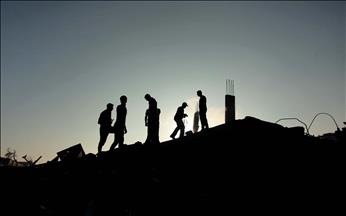
Israeli warplanes have struck hundreds of targets across the besieged enclave, which is home to around 1.8 million Palestinians. Israeli ground troops remain massed on the territory’s borders in advance of a potential ground assault.
At least 194 Palestinians, mostly civilians, have been killed in Israel’s weeklong air campaign, and casualties continue to mount.
The Israeli Defense Forces say that more than 1,000 rockets have been fired at Israel.
No Israeli fatalities have been reported thus far.
“Israel is indeed bombing and besieging areas with a high-density civilian population and as a result they are indeed killing many civilians. In fact, the majority are civilians,” said Lisa Goldman, the director of the Israel-Palestine Initiative at the New America Foundation think tank, while speaking exclusively to AA. “This is obviously extremely regrettable and something that should be avoided.”
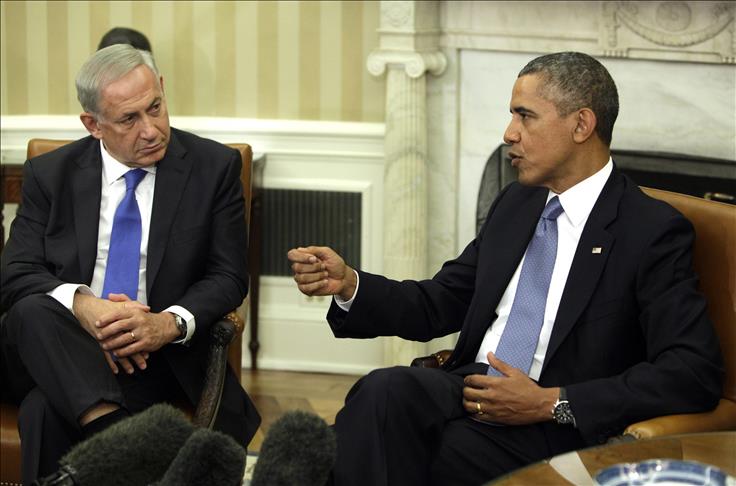
Speaking to the press on Monday, White House Press Secretary Josh Earnest said that the Obama administration has not seen any evidence of Israeli war crimes, or of the use of disproportionate force by Israel. He added that Washington is working to diffuse tensions alongside Israeli and Palestinian officials.
And yet, it may be Washington’s close ties with Tel Aviv that undercut any efforts it may take to diffuse tensions.
“The United States government continues to present itself as an honest and unbiased broker, and that it can try to bring these two sides together," said Rochelle Davis, an associate professor at Georgetown University in Washington, D.C. "That I think is fundamentally a semantic deception that the U.S. government puts out there.”
Without substantial policy change, the U.S. government cannot serve as the honest broker it claims to be, she added.
But experts warn that Gaza’s dire humanitarian situation existed long before the current military confrontation.
“The fabricated picture which is being repeated in the media is that Israel is the victim, and Palestinians are constantly firing against innocent Israelis, and if only these Palestinians would stop, then there would be peace,” said Ali Abunimah, the co-founder of the Electronic Intifada, an online publication. “The reality is never reflected.”
Israel’s blockade of the Palestinian enclave, in place since Hamas’ takeover in 2007, has crippled the local economy. Imports are severely curtailed, exports are denied, fishing is restricted and much of the enclave’s arable land near the Israeli border lies fallow following Israel’s unilateral declaration of a “security buffer zone”.
The up-to-1.5 kilometer deep zone encompasses 34 percent of Gaza’s arable land, according to the UN’s Food and Agricultural Organization, denying farmers a key resource.
“You have a population in Gaza that can do nothing without Israel’s approval or without a tiny border with Egypt that allows stuff in and out,” said Davis. “The fact that they don’t have access to gasoline, electricity and water unless Israel or Egypt allows them to is a huge problem for people which we aren’t recognizing.”
Highlighting the crisis there, Abunimah, the Electronic Intifada cofounder, said that roughly two-thirds of Gaza’s population is dependent on humanitarian aid, which has not stopped the U.S. from continuing to support Israel's policies.
“They stand with the victims of human rights abuses and occupation elsewhere except, when it comes to Palestine, they always stand with the occupation and the aggression,” he said.
www.aa.com.tr/en