By Handan Kazanci
ISTANBUL
For three decades, Turkey has fought a bloody insurgency waged by the Kurdistan Workers’ Party that has cost tens of thousands of lives.
But now a solution to the conflict, which pits Turkey's largest ethnic minority against the government, may at last be close at hand.
The government and the Kurdistan Workers' Party, also knows by the initials PKK, entered into a cease-fire last year, after talks -- referred to here as the "solution process" -- began between the government and the party.
Hopes dipped in September, when the cease-fire was breached due to spillover from the civil war in Syria, Turkey's neighbor to the south.
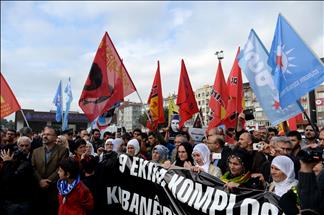
Demonstrations broke out to show solidarity with the Kurdish-populated Syrian town of Kobani, which is besieged by militants of the Islamic State of Iraq and the Levant, or ISIL.
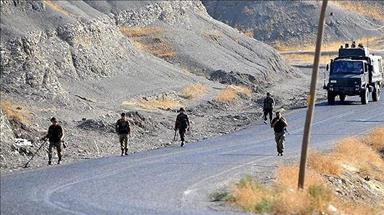
Reacting to what it said was the Turkish government's harsh treatment of Kurdish refugees from Syria, the PKK killed three Turkish policemen.
Fears grew that the conflict might re-ignite.
Yet in the past week or so, a series of developments seems to indicate movement beneath the surface of the talks.
The landscape may be changing. A solution to the long and bloody conflict could be within reach.
“For the first time in Turkey’s history, both sides are close to a substantial deal," said Yunus Akbaba, a researcher with the Ankara-based SETA Foundation for Political, Economic and Social Research.
This would be a momentous development for Turkey. Turks and Kurds have peopled this land for centuries.
Eighteen percent of Turkey's more than 80 million people are Kurds, according to estimates. They are concentrated largely in the southeast of the country.
And the conflict of the last 30 years has led to the deaths of an estimated 40,000 people, the listing of the PKK as a terrorist organization by Turkey, the U.S. and the EU, and the frustration of the aspirations of the Kurds themselves.
The recent developments include:
* Reports in the Turkish media that "a new page" has been turned in the reconciliation process.
* The announcement that a parliamentary delegation will soon visit PKK leader Abdullah Ocalan, who has been imprisoned on Imrali island, in the Sea of Marmara, since 1999.
The announcement was made by leaders of the pro-Kurdish People's Democratic Party following a 90-minute meeting with Turkey's justice minister.
* A parallel announcement in which People's Democratic Party leaders said that five convicts imprisoned with Ocalan would work as his "secretariat" during the peace process.
* The agreement by Deputy Prime Minister Yalcin Akdogan to the formation of an independent committee to be a "third eye" objectively monitoring the process.
The new committee, half of whose members will be appointed by the government and half by the Peoples' Democratic Party, will consist of academics, writers and people from nongovernmental organizations.
The committee's formation is of critical importance, said Mesut Yegen, a sociologist from Istanbul’s Sehir University, who has written several books on the Kurdish issue.
"Actually the negotiation has not started yet," Yegen said. "There are ongoing talks, but the public does not know what is being discussed during the meetings."
There are an estimated 30-35 million Kurds in the world, spread largely over adjacent areas of Turkey, Syria, Iraq and Iran.
They have lived in the region for more than 1,200 years and have been fighting against authority since the 19th century, Yegen said.
But they are far from a homogenous group. There is not even a single Kurdish language, but rather two main branches of Kurdish, along with numerous dialects.
Many Kurds, though not all, have for years longed for a state of their own -- an independent Kurdistan.
That idea has been strongly resisted by the countries in which they live. However, Kurds in Iraq -- where they make up perhaps 25 percent of the population -- now govern a semi-autonomous region in the country's north.
In Syria, Kurds make up about 15 percent of the population.
The largest Kurdish movements in Turkey, Syria and Iraq are all secular. But, there again, the group is diverse.
News reports over the past two months have confirmed that some Kurds are fighting with ISIL – and against secular Kurds.
In the 1990s, Turkey witnessed its own bloody inter-Kurd civil war between the secularist PKK and the Islamist Kurdish Hizbollah movement, which is unconnected to the militant group in Lebanon of the same name.
Despite these internal divisions, the past three years have radically changed the landscape of the Kurdish movement.
The slow-burn disintegration of the Middle East since 2011 has allowed Kurdish autonomy to become entrenched in Iraq and nascent in Syria.
And the place of Kurds in Turkish society -- where, for about a decade, even the use of the Kurdish language was banned -- may now be in the process of being decided.
Akbaba, the researcher from the SETA Foundation, said the process should not be seen as starting from scratch.
In 2005, then-Prime Minister Recep Tayyip Erdogan made a famous speech on the issue in Diyarbakir, a province in southeastern Turkey with a significant Kurdish population.
"The Kurdish issue is my own concern," he proclaimed.
And in the years since, there have been various attempts at finding a solution.
While the talks now taking place are between politicians, there is huge support from the public.
"In general, support for the reconciliation process runs at 57 percent," according to research conducted in 2014 by Hakan Yilmaz, a professor at Bosphorus University in Istanbul.
And among Kurds, Yilmaz' report said, support is as high as 83 percent.
Turkey’s Kurds no longer face the widespread and systematic discrimination of the past and in the coming weeks, the nation's agenda looks set to be dominated by the solution process.
www.aa.com.tr/en