Extra Gallipoli commemorations start in Turkey
Huge interest in centenary year of Battle of Canakkale sees extra memorial events at battle site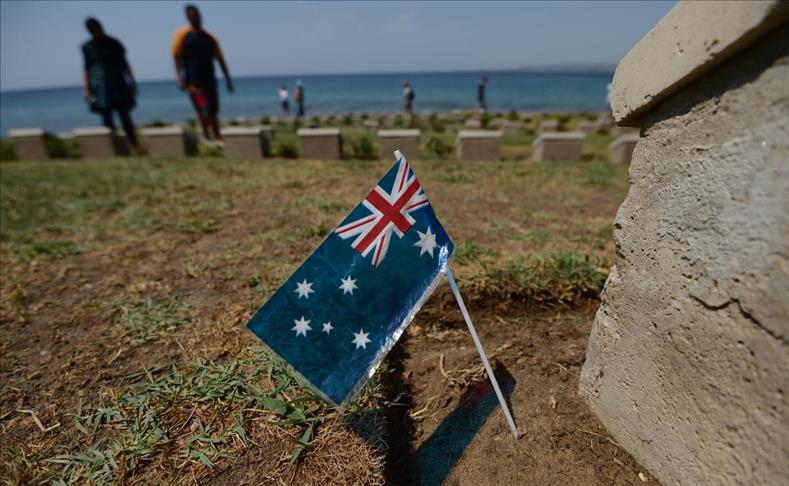
GELIBOLU, Turkey
Additional ceremonies to commemorate 1915’s Gelibolu (Gallipoli) fighting have been held in Turkey’s northwestern province of Canakkale, scene of the pivotal World War One conflict.
Australian Governor-General Sir Peter Cosgrove, Canakkale Governor Ahmet Cinar and Australian consul Nicholas Sergi attended the first event on Thursday.
Cosgrove and Cinar placed wreaths at the Turkish 57th Infantry Regiment cemetery. Some visitors also left flowers on symbolic tombs at the site.
Speaking to the press after the ceremony, Cosgrove said that he was “a very proud Australian, honored to be here at this place where very brave men defending Turkish soil fought and died”.
“The 57th Regiment is one of the most famous regiments of modern Turkey,” he said, adding that it “represented a path for the Turkish resistance at Gallipoli which turned the battle for Turkey”.
“The 57th Regiment is no longer on the Turkish order of battle but it lives on, and while people visit this memorial, the regiment will never die,” he said.
Canakkale Governor Cinar emphasized the importance of the 1915 fight which eventually resulted in friendship between the opposing nations.
Tens of thousands of Turkish nationals and soldiers died in the eight-month campaign, along with tens of thousands of Europeans, plus between 7,000 - 8,000 Australians and nearly 3,000 New Zealanders.
Aboriginal and Torres Strait Islander troops remembered
Another event took place at Anzac Cove on Gallipoli peninsula which was the ANZAC (the Australian and New Zealand Army Corps’) landing site at the start of the battle in April 1915.
Cosgrove and an accompanying delegation followed a ceremony to pay tribute to Aboriginal and Torres Strait Islander troops from Australia.
Although Aboriginals and Torres Strait Islanders were excluded from serving in the armed forces during WWI, many served voluntarily at Gallipoli, according to Australia’s Department of Veterans’ Affairs.
More than 300 people attended the ceremony where a spiritual ritual with smoke and arrows took place.
“In traditional Aboriginal society death is a time when a spirit is released from the physical body to rejoin the unseen world,” organizers said, adding: “Ceremonies surrounding death facilitate the spirit returning to its home.”
Ceremony at Lone Pine
Another Australian service took place at the Lone Pine Cemetery where the Australian Army Band and the Gregory Terrace-All Hallows’ Gallipoli Choir led by Major Peter Thomas performed.
Australian, New Zealander, Canadian, Indian and Turkish officials attended the ceremony.
Addressing an estimated 500-strong audience at the site where Australian troops mounted a diversionary attack on the Ottoman trenches in August 1915, Governor-General Cosgrove said that Thursday’s gathering reflected a remarkable period in modern world history, which affected not only Australia but the entire world.
“The great battles of August 1915, here at Lone Pine and elsewhere on the Gallipoli battlefields, were for the senior commanders the ‘last throw of the dice’,” he said.
“They were an all-out push to gain the high ground and beyond to finally control one side of the Dardanelles. After these battles, although it took several more months, withdrawal was the only option left,” he added.
Cosgrove said that thousands of soldiers died on both sides “in the dark depths of trenches with bayonet and club and bomb”.
“We thus say to them our benediction: ‘Rest in Peace, Johnnies and Mehmets together,’ he added in a reference to Turkey’s founder leader Mustafa Kemal Ataturk’s words.
After Cosgrove’s speech the crowds stood in silent for a minute for those who lost their lives during the campaign. The national anthems of both countries were also sung.
A series of extra remembrance ceremonies will be held over the next three days, arranged to accommodate the huge numbers of visitors during the centenary year of the Gallipoli landings.
On Saturday, August 8, another event for New Zealanders will be held at the Chunuk Bair Memorial -- located on a hill that, in August 1915, was one of the Allied forces’ main objectives and where many New Zealanders lost their lives.
This year marks 100 years since the conflict in the Dardanelles Strait, which became a turning point for Turks fighting against the invading Allies during WWI.
More than 43,000 Australians and New Zealanders had applied to attend this April’s main annual commemorations but just 10,000 places were available.