Anadolu Ajansı © 2026


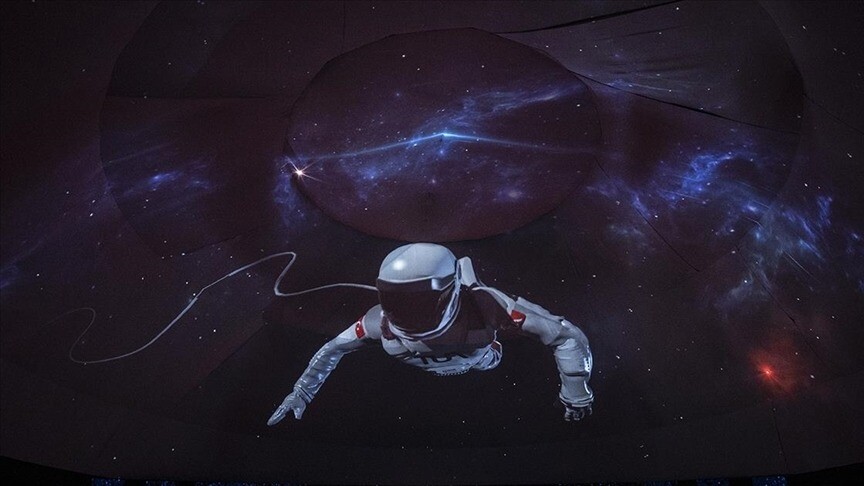
On a festive night in 1633, as Istanbul celebrated the birth of Kaya Sultan, the daughter of Ottoman Sultan Murad IV, an inventor known as Lagari Hasan Celebi is said to have mounted a seven-branched rocket packed with gunpowder paste on the shores of the Bosphorus.
When the powder burned out, as the story goes, he opened a pair of wings he had built himself, descended into the sea in front of the Sinan Pasha mansion and swam back to shore.
The episode is recorded by 17th-century Ottoman traveller Evliya Celebi in his Seyahatname, or Book of Travels.
Nearly four centuries on, the “rocket man” gives his name to a satellite and space museum operated by Turksat, Türkiye’s state-owned satellite operator.
Decades earlier, in 1577, the Ottoman astronomer Takiyuddin established the landmark Istanbul Observatory, where he conducted astronomical observations and developed instruments for measuring celestial movements. Equipped with a large armillary sphere, mechanical clocks capable of measuring time in seconds, and other precision instruments of his own design, the facility ranked among the most advanced of its age.
From observatories and early experiments in flight to satellites and human spaceflight, Türkiye’s relationship with the sky has evolved dramatically.
From Oct. 5 to 9, the country’s space program will be on show before the global space community, when the 77th International Astronautical Congress (IAC 2026) opens in the Turkish resort city of Antalya.
It is the first time the annual gathering, organized by the International Astronautical Federation (IAF), is being held in Türkiye.
The 1990s brought Türkiye's first major step into satellite communications.
Turksat 1B was launched in August 1994, becoming Türkiye's first communications satellite, followed by Turksat 1C in 1996.
The country's ambitions increasingly shifted from operating satellites made elsewhere toward designing and building spacecraft itself.
RASAT, launched in 2011, was the country's first domestically developed Earth-observation satellite, while GOKTURK-2, launched in 2012, became Türkiye's first high-resolution Earth-observation satellite.
In 2023, IMECE, a high-resolution Earth-observation satellite designed and built by TUBITAK UZAY, the country's space research institute, was launched aboard a SpaceX Falcon 9 from California. According to the institute, it featured Türkiye's first space-compatible electro-optical camera, along with domestically developed electric propulsion, star trackers, reaction wheels and other key systems.
TURKSAT 6A, launched in 2024, became Türkiye's first domestically developed communications satellite, putting the country among 11 countries with the capability to build their own.
The turning point came on Dec. 13, 2018, when a presidential decree set up the Turkish Space Agency (TUA) under the Ministry of Industry and Technology. Its mandate included preparing and implementing the National Space Program and setting longer-term priorities for space and aerospace science and technology.
That program was unveiled in 2021 with a 10-year vision.
Its goals included reaching the Moon, developing a globally competitive commercial satellite brand, establishing a regional positioning and timing system, creating independent access to space and a spaceport, improving astronomical observation and space-object tracking capabilities, as well as developing a domestic space industry and technology-development zone. A human space mission was also included among the program's objectives.
The first major public milestone arrived sooner than some of the longer-term goals.
In 2024, Alper Gezeravci became the first Turkish citizen to travel to the International Space Station, spending 18 days in orbit as part of Axiom Mission 3. He carried out 13 scientific experiments prepared by Turkish universities and research institutions.
Four months later, Tuva Cihangir Atasever conducted a suborbital research flight, carrying out seven scientific experiments.
The most ambitious item on that list is now within reach.
In mid-September, Industry and Technology Minister Mehmet Fatih Kacir announced that production, assembly and system integration of Türkiye's first lunar spacecraft had been completed.
The roughly 3.5-ton vehicle was developed under the leadership of TUBITAK UZAY as part of the Lunar Research Program, known by its Turkish acronym AYAP. It has been handed over to the Space Systems Integration and Test Center (USET) at Turkish Aerospace (TUSAS) for system-level environmental testing.
According to Kacir, more than 80% of the vehicle was produced domestically, and all of its software was written in Türkiye.
Once testing is over, it will be shipped to the Kennedy Space Center in the US for launch, as the lift-off is planned for the first months of 2027.
After a journey of about two months, the spacecraft is expected to settle into a circular polar orbit some 100 kilometers above the lunar surface and operate there for at least three months. A hybrid propulsion system developed in Türkiye is to handle its maneuvers, including a controlled descent to the surface at the end of the mission.
Kacir said the program, launched in early 2022, had reached 77% completion, with more than 200 engineers contributing.
Noting that only eight countries have so far carried out a Moon mission, the minister said: "With our Lunar Research Program, which we will carry out with our own engineering capabilities, we aim to become the ninth."
Under the 2021 road map, this mission is the first phase. A second phase envisages a launch on a national rocket and a soft landing on the Moon.
Türkiye also wants to be able to put its own satellites into orbit from its own launch site.
Last year, Turkish President Recep Tayyip Erdogan announced that Türkiye plans to build a spaceport in Somalia under agreements signed between the two countries. He made the announcement at a joint news conference in Istanbul with Somali President Hassan Sheikh Mohamud.
Minister Kacir said feasibility studies had identified Somalia as the most suitable location. He cited its proximity to the equator, its ocean coastline, weather that allows launches year-round and low air and sea traffic.
The feasibility and design work had been completed and first-phase construction had begun, he said, adding that the site would serve both national needs and the commercial launch market.
As for rockets, defense company Roketsan is developing a Micro Satellite Launch System designed to place satellites of at least 100 kilograms into a 400-kilometer orbit.
The country's space ambitions is being backed by a growing budget. Under the 2026 central government budget, Türkiye allocated a record 8.729 billion liras to space and aviation activities this year, up from 5.052 billion liras in 2025.
In December 2025, TUA President Yusuf Kirac was unanimously elected council chair of the Asia-Pacific Space Cooperation Organization (APSCO) for 2026-2027. He is the first Turkish representative to hold the post.
Ankara has also stepped up its space diplomacy. On Aug. 31, Kacir signed the Artemis Accords at NASA headquarters in Washington. That made Türkiye the 71st signatory to the US-led set of principles for peaceful and sustainable exploration of the Moon and beyond.
The signing came just weeks before Türkiye hosts its first International Astronautical Congress.
From Oct. 5 to 9, Antalya will host the 77th International Astronautical Congress, the world’s largest space gathering, marking the first time the event has been held in Türkiye.
Organizers expect more than 10,000 registered participants, including space agency chiefs from around the world, industry executives, engineers, scientists and students. This year's theme is The World Needs More Space.
The event is hosted by Türkiye's national space agency TUA and co-hosted by SAHA, a Turkish defense and aerospace industry cluster.
news_share_descriptionsubscription_contact

contact_the_ombudsman
is_there_an_error_in_this_story