By Shazia Yousuf
SRINAGAR, Indian-held Kashmir
An apparent militant targeting of telecoms companies in Indian-held Kashmir resumed on Friday when two showrooms in Kashmiri capital Srinagar were hit by grenade blasts.
Indian police said two youth forced everyone out of one of the phone companies' showrooms before throwing a grenade in, and that minutes later a similar incident happened at another shop, though there were no casualties.
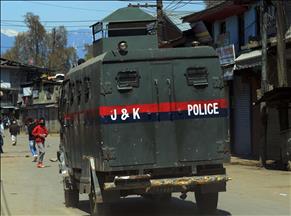
Both attacks happened less than 300 metres from the Indian Police’s heavily fortified zonal headquarters in Kashmir valley.
Friday’s attack came a day after the Pakistan-based militant organization Hizbul Mujahideen expelled one of its top Kashmiri commanders, Abdul Qayoom Najar, for carrying out attacks on telecom companies in May.
The attacks on the telecommunications firms started two months ago when a little known militant outfit, Lashkar-e-Islam, put up posters in northern Indian-held Kashmir's Sopore town, urging all telecom providers to end operations.
Attacks followed on telecom businesses and people associated with the trade with six civilians being killed at point-blank range in the space of a week, including close associates of senior Kashmiri pro-independence leader Syed Ali Shah Geelani.
After an internal inquiry, Hizbul Mujahideen expelled one of its most senior commanders and operations head in Indian-held Kashmir, Najar, from the outfit. In its statement, the group hinted that the Lashkar-e-Islam outfit was a brainchild of Najar.
“The report submitted by the inquiry commission has proved that Qayoom Najar in an utter disregard to the Hizb leadership violated the constitution of the outfit and carried out condemnable acts which our constitution does not allow or permit,” the group's spokesperson Saleem Hashmi said on Thursday. "Such anti-people activities always prove counterproductive for the freedom movement and advertently or inadvertently such acts help the anti-movement elements."
Najar, who joined the militancy as a 16-year-old in 1995, is one of longest surviving active militants in Kashmir.
According to the Indian police, 10 to 15 militants under the leadership of Najar had rebelled against the Hizbul Mujahideen's command and acted on their own, after differences with the Muzaffarad-based chief Syed Salah-ud-din.
Kashmir, a Muslim-majority Himalayan region, is held by India and Pakistan in parts and claimed by both in full.
The two countries have fought three wars -- in 1948, 1965 and 1971 -- since they were partitioned in 1947, two of which were fought over Kashmir.
Since 1989, Kashmiri resistance groups in Indian-held Kashmir have been fighting against Indian rule for independence or for unification with neighboring Pakistan.
More than 70,000 Kashmiris have been killed so far in the violence, most of them by Indian forces. India maintains over half a million soldiers in the Indian-held Kashmir.
A part of Kashmir is also held by China.