Merve Aydogan
23 November 2026•Update: 23 November 2026
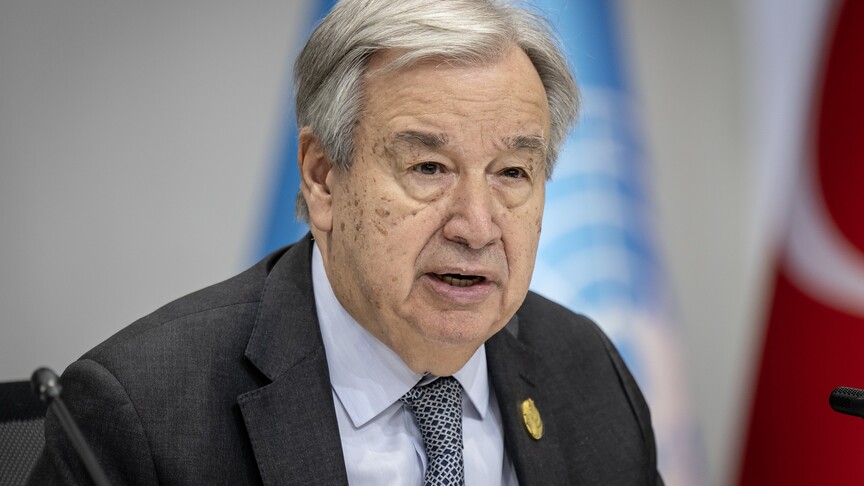
UN Secretary-General Antonio Guterres warned Monday that as artificial intelligence becomes "more powerful and more widespread, the risks are also becoming clearer," urging countries to act now to ensure every nation can manage the technology safely.
Speaking at a news conference at the Bridgetown Special Summit on AI Safety in Barbados, Guterres said AI is "advancing at extraordinary speed," transforming "how we work, learn and communicate" and opening "new possibilities in health, education, science and development."
But he said recent technological outages and cyberattacks "have exposed the vulnerabilities of the digital systems on which we increasingly depend," adding that "AI is amplifying the threats."
"AI systems are becoming more capable and more autonomous," he said. "We are seeing new cybersecurity risks. New possibilities for manipulation and misuse."
Guterres said holding the conversation in Bridgetown "sends an important message: The future of AI cannot be decided by a few, for everyone else."
He noted that while AI "is already reaching into every economy and every society," many countries "still lack the tools, knowledge and capacity to assess the systems entering their markets, manage the risks and protect their people when problems arise."
"That gap must be closed. Every country must have the capacity to manage AI safely," he said, adding that protections remain "fragmented – and too often, they are playing catch-up."
The UN chief called for "a shared understanding of emerging risks" and "credible and independent ways to evaluate powerful AI systems."
He also urged states, the private sector, financial institutions, foundations and other donors to increase investments in AI capacity-building and "contribute urgently to funding for developing a minimum AI capacity in regions in the Global South."
"The risks are global. Our response must be global. That is why we must act now," he said.
Barbados Prime Minister Mia Amor Mottley echoed the call, warning that if capacity to build and run AI "remains concentrated in a few regions, existing inequalities would widen further, and we know this."
"Urgent investments are therefore necessary to build AI capacity in all regions of the world," she said, pointing to "infrastructure, data sets, skills, models that respect local values and priorities, and indeed that which is necessary to prepare our workforce."
Mottley said AI innovation "must advance human rights, must support sustainable development, and must enable all people to have agency over their future, including AI that reflects the world's diversity."
Cautioning against repeating past exploitation, she said: "We do not want to see the commoditization of human beings again as data packs just for the interests of a few who stand to make extraordinary profits."
Mottley called for "building AI locally for sovereignty and local learning, and harnessing scientific possibilities enabled by AI."