WASHINGTON, D.C.
A reduced number of Ezidis stranded atop Mount Sinjar in northern Iraq means an evacuation has become "far less likely," the Pentagon said Wednesday, as the U.S. carried out further air strikes on militants from the Islamic State group.
A team of U.S. military personnel and aid workers found "there are far fewer" Ezidis still stranded on the mountain than initially thought, and those "who remain are in better condition than previously believed and continue to have access to the food and water that we have dropped," Pentagon Press Secretary Rear Admiral John Kirby said in a statement released to the press.
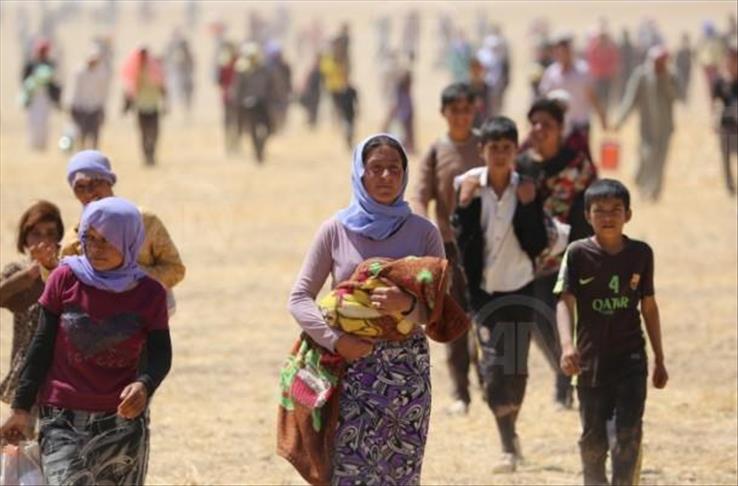
Thousands of Ezidis were able to flee the mountain each night for the past several days, according to Kirby.
"Based on this assessment the interagency has determined that an evacuation mission is far less likely," he said. "We will continue to provide humanitarian assistance as needed and will protect U.S. personnel and facilities."
A defense official announced on Tuesday that 130 additional American troops would be sent to northern Iraq to plan further humanitarian assistance options for refugees besieged by Islamic State militants on Mount Sinjar.
U.S. President Barack Obama has insisted that U.S. combat troops will not return to Iraq, after withdrawing in 2011.
The U.S. also continued its air campaign against Islamic State targets in northern Iraq for a sixth consecutive day on Wednesday, destroying an armed truck west of the village of Sinjar, according to U.S. Central Command.
A drone carried out the strike at roughly 4:20 p.m. GMT near an Islamic State checkpoint.
Obama authorized targeted air strikes last Thursday to protect American personnel in the northern Iraqi city of Erbil and support forces in Iraq as they fight to break the siege of Mount Sinjar, where thousands of Ezidi civilians have sought refuge from Islamic State militants.
On Saturday, President Obama warned it was "going to take some time" to help stabilize Iraq in the face of the insurgency.
The violence in Iraq escalated in early June after a coalition of armed groups linked to the Islamic State, formerly known as the Islamic State of Iraq and the Levant, or ISIL, took control of large swathes of the country's predominantly Sunni provinces.
Amid fierce clashes with the Iraqi army and the Kurdish peshmerga forces, the insurgents have tightened their grip on northern Iraq, seizing towns with minority populations, as well as Iraq's largest dam near Mosul.
The militants captured Sinjar and Rabia in Nineveh province last week, forcing thousands of Turkmens, Arabs, Christians and Ezidis to flee.
Ezidi MP in good condition says Turkish lawmaker
An Ezidi lawmaker from the Iraqi parliament, whose emotional plea in parliament drew attention to the atrocities her people were suffering at the hands of millitants from the Islamic State (IS) is in good condition after surviving helicopter crash on Tuesday, according to a Turkish MP who visited her in hospital in Istanbul.
Vian Dakhil was wounded after a helicopter rescuing stranded Ezidis on Sinjar Mountain crashed during takeoff alongside with other some 20 people including journalists on Tuesday. The pilot of the helicopter died in the crash.
"She is not under any critical condition, except her broken left foot and contusion in her ribs," said pro-Kurdish HDP MP Ertugrul Kurkcu to press.
Two New York Times journalists, who were injured in the same crash, were brought to Turkey for treatment.
Netherlands to provide aid for Ezidis on Mount Sinjar
The Dutch government has decided to provide humanitarian aid for Ezidis in Iraq who took refuge on Mount Sinjar from terrorist attacks by the Islamic State (IS).
Foreign Trade and Development Minister, Lilianne Ploumen, told the Dutch parliament on Thursday that foodstuffs, water and blankets would be provided to Ezidis on Mount Sinjar.
Ploumen said the decision to provide aid followed meetings by different partners and civil society organizations in the region. She said Australian troops in the region would distribute the aid - worth 1 million Euro - in the form of airdrops.
The relief supplies will be provided by money transferred from emergency funds, according to Ploumen.
In a plane belonging to the armed forces of the Netherlands, aid supplies will be taken to the United Arab Emirates on Sunday and delivered to the Australian troops.
www.aa.com.tr/en