
Ghannouchi says Tunisia better off five years after revolution
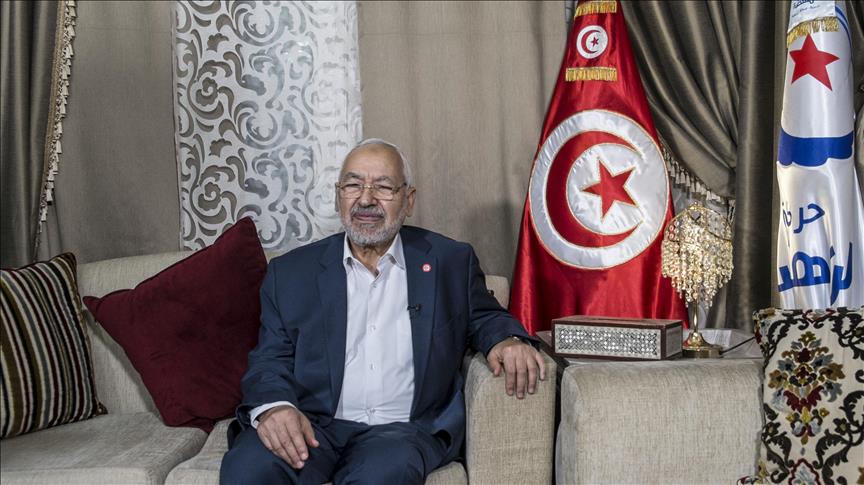
In first of two-part interview, leader of Ennahda Party Rashid Ghannoushi speaks to Anadolu Agency about where Tunisia stands five years after revolution
TUNIS, Tunisia
Five years have passed since the Tunisian revolution ended the rule of former President Zine El Abidine Ben Ali, inspiring a number of other Arab countries to follow
On the anniversary of this historic event that has inspired the Arab Spring, Anadolu Agency interviewed Rashid Ghannoushi, the influential leader of Ennahda Party.
In the first of this two-part interview, Ghannoushi spoke to Anadolu Agency about where Tunisia stands five years after the revolution.
Anadolu Agency (AA): Is Tunisia on the right path?
Ghannouchi: The revolutionary path is successful and we are entering the 6th year. Tunisia did not only preserve the revolution. It also transformed it into a democracy in a tough region [of the world].
Tunisia advanced on the path of democracy, wrote a new constitution and created constitutional institutions like the Constitutional Court, a commission for transitional justice, a justice council, electoral bodies and agencies to monitor the media, which are all independent.
By the end of this year, we will have, for the first time, free regional and municipal elections and by doing so, we will accomplish the democratic process.
When it comes to security, we are facing real difficulties. Terrorism is a challenge, which is related to the socio-economic challenge, including the high rates of unemployment that we did not succeed in reducing.
AA: Some analysts say the economic situation in Tunisia is worsening day by day due to the absence of investments and tourism’s catastrophic situation. Can we consider this as a threat to state institutions? Can the fragile economy trigger a second revolution?
Ghannoushi: There is no serious talk about a second revolution. There have been no setbacks in this revolution for a second revolution to take place.
If you mean a
There are difficulties. It is not new in Tunisia that strikes happen. During the last five years, we witnessed a large number of strikes and protests, but things have remained under control.
AA: On the 5th anniversary of the revolution, what is your message to Tunisians and the world?
Ghannoushi: Tunisians have to trust in their revolution more and realize that revolutions do not achieve their goals overnight. Freedom has a price. Because of this revolution, Tunisians are free.
Tunisians should be patient and make up their mind to restore the concept of work so that they can achieve the second goal of the revolution: employment,
Tunisia possesses a significant potential for development. Tunisia is supported internationally. Tunisia is providing an example of democratic Islam, which is in the interest of [Tunisia] and the world.
My message to the world is that Tunisian democracy is a gain for all of us. Today, there are two confronting paradigms in Islam, the Daesh
Billions have been invested in fighting terrorism. A few billion should be directed to support democracy, which is the substitute of terrorism and the wrong interpretations of Islam.
AA: How do you evaluate the coalition with Nida Tounes (Call of Tunisia)?
Ghannouchi: Ennahda is in power today. We are a partner in power and we insist on this partnership. Talk about clashes between Nida and Ennahda is not true. No rivalry took place between our sympathizers. There are disputes inside Nida and not between Nida and Ennahda.
Ennahda believed in the idea of coexistence advocated by the president of the republic. Ennahdha believed in the path of consensus and we created coordinating bodies between the four allied parties.
We will continue on the path of consensus and partnership. Disputes inside Nida should be solved by Nida, not Ennahda. Regardless, Ennahda is the biggest supporter of the government and we will continue to be.
Anadolu Agency website contains only a portion of the news stories offered to subscribers in the AA News Broadcasting System (HAS), and in summarized form. Please contact us for subscription options.