
One-week-old Syria truce marred by ongoing fighting
Civilian casualties, however, appear to have fallen since cessation-of-hostilities deal came into effect
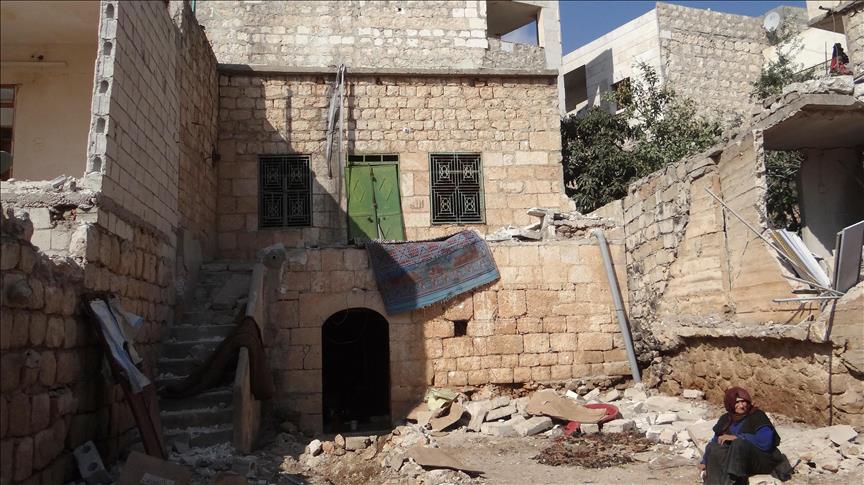 Residential areas in Darat Izza town of Aleppo, Despite a temporary cessation-of-hostilities agreement went into effect in Syria on midnight Friday, first hours of 27th of February, Russia staged air-strike. ( Ahmed Hasan Ubeyd - Anadolu Agency )
Halab
By Halit Suleyman, Mohamad Misto and Selen Temizer
ANKARA/ALEPPO
During the first week of a cessation-of-hostilities agreement in Syria, Russia and the Assad regime have continued attacking opposition-held positions, although civilian casualties have decreased in frequency due to fewer attacks on residential areas.
Truce violations were committed immediately after the agreement came into effect on Feb. 27, with the regime and Russia continuing to strike targets in Latakia province’s Turkmen Mountain region; western parts of Aleppo province; southern parts of Idlib province; the Eastern Ghouta region east of Damascus; and Daraa province’s central and western areas.
According to local sources, however, civilian losses have been comparatively fewer across the country -- with the exception of Latakia and Daraa -- since the truce came into effect.
75 civilians killed
According to the London-based Syrian Network for Human Rights, 216 violations occurred across the war-battered country -- in which 75 civilians were killed -- within the last week.
Meanwhile, despite the reduced rate of civilian casualties, some besieged areas were prevented from receiving humanitarian aid.
Out of 18 besieged areas across Syria, humanitarian aid was only allowed into Muadamiyat al-Sham town southwest of Damascus and Kafr Batna town in Rif Dimashq province’s Eastern Ghouta area.
According to local sources in Muadamiyat al-Sham, 10 humanitarian aid trucks were allowed into the town after having been blocked by regime forces.
The trucks, however, only included sanitation and food supplies and lacked medical supplies needed by patients suffering chronic illnesses.
Meanwhile, seven trucks carrying medical supplies and another eight carrying foodstuffs were allowed into Kafr Batna, but these were only sufficient to meet the needs of about one third of the town’s population.
And in Homs province’s Rastan city, local sources said no humanitarian aid had been delivered within the last seven months, leading to severe bread shortages.
Rastan’s local council has asked the UN to provide humanitarian aid to the city, which remains besieged by Assad regime forces.
UN Syria envoy Staffan de Mistura, for his part, said the cessation-of-hostilities deal -- brokered last month by the U.S. and Russia -- was holding for the most part, despite continued fighting in Hama, Homs, Latakia and Damascus.